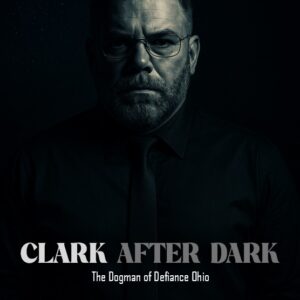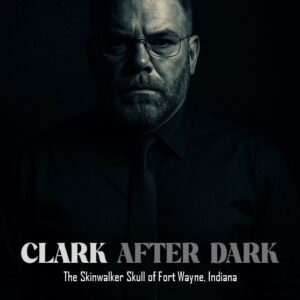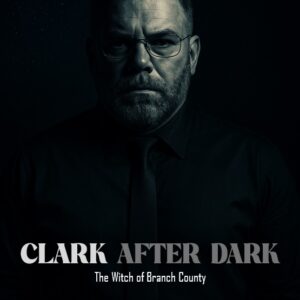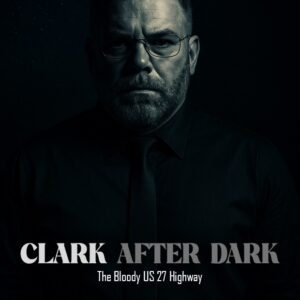
Originally written by Berg X, for We Live Journal / WLDW Archives, 2012
If you drive through northern Indiana after midnight, tuning the dial between AM frequencies, there’s a stretch of static that seems to breathe. It flickers between church broadcasts, trucker chatter, and white noise, until a voice cuts through like an ember in fog. Calm, measured, almost polite:
“You’re listening to Clark After Dark. We’re alive tonight. Somewhere.”
That voice belongs to Clark, host of Clark After Dark, a late-night radio program that drifts across the Midwestern airwaves from an untraceable signal listed as WLDW AM — We Live Radio. The show began appearing in the early 2000s, though station records list it decades older. No one has confirmed its physical studio, but the signal’s reach — roughly 300 miles around Fort Wayne, Indiana — has become known locally as the Shadow Belt: a corridor of fading factories, dead malls, and unexplained phenomena stitched together by one man’s voice.
The Shadow Belt
The phrase started as geography, a nod to the old Rust Belt counties left hollow by industry’s retreat. But on Clark After Dark, it took on a deeper meaning — a psychic shadow stretching across the heartland, a region where memory and machinery decay at the same rate.
Listeners call in from places that feel like the edge of time: Kokomo, Lima, Marion, Terre Haute, Youngstown. They talk about lights moving against the wind, voices from unplugged radios, time bleeding through the cracks of old steel mills. Some stories are ordinary. Others feel centuries old. Clark never interrupts. He simply asks:
“How long has it been happening?”
That question — not what but how long — became the show’s signature. Because in the Shadow Belt, things don’t necessarily begin or end. They just continue. A caller once described it as “the Midwest’s magnetic field for the forgotten.” Another said, “It’s where you can hear the world trying to start over again.”
The Voice in the Static
Clark himself rarely gives interviews. The few who have met him describe a tall man with calm hands, always slightly overdressed for radio. His listeners know him for his voice — rich, unhurried, with a tone that feels like it’s remembering something you’ve forgotten. He doesn’t argue with callers, doesn’t correct them, doesn’t offer proof. Instead, he lets silence do the heavy lifting.
“People don’t come here for belief,” he said during one rare on-air self-reflection. “They come here because belief is all they have left.”
The show’s topics range from the strange to the ineffable: shadow figures seen during solar storms, mirrors that record sound, a lake in Ohio that allegedly reflects only what’s about to happen. Some nights, Clark reads old newspaper clippings about train derailments and factory fires — tragedies whose witnesses have long since died. Other nights, he speaks about “thin hours,” those stretches of time when the frequencies between stations pulse like a second heartbeat.
His following is small but devoted: long-haul drivers, night-shift nurses, insomniacs, and amateur paranormalists scattered across six states. Many report hearing Clark After Dark on frequencies that shouldn’t exist, or replaying episodes that never aired. A few claim the show continues long after sign-off, broadcasting beneath the hum of refrigerators, vending machines, even power lines.
We Live Radio
No one’s been able to pinpoint WLDW’s transmitter. FCC records list it as “experimental.” Engineers who’ve analyzed the broadcast note a faint multi-tone hum embedded in the signal — an analog heartbeat that doesn’t match any known modulation pattern.
Some think We Live Radio began as a university frequency, part of a communications project that went rogue. Others suspect it’s a community station hijacked by enthusiasts. But then there are the stranger theories: that the station sits in a space between time zones, or that the broadcast originates from a repeater tower that no longer exists.
“WLDW is like the Midwest’s own ghost signal,” says radio historian Laura Nagle. “Its call letters don’t appear in modern databases, and yet people hear it all the time. The strangest part? The weather in its broadcasts never matches the real weather outside.”
Archived recordings show a lag — a static echo that bends the timestamps backward by a few minutes. It’s as if the show’s own signal is listening to itself, always slightly in the past.
Clark never addresses this directly, except once:
“Don’t worry about the delay,” he told a nervous caller. “It just means we’re still catching up to you.”
Broadcasting From the Liminal Midwest
The Shadow Belt isn’t just a map radius. It’s a cultural corridor between the known and the neglected. Abandoned drive-ins. Evangelical truck stops. Silence stretching over the flat miles of corn and steel.
Clark’s show doesn’t exploit this decay — it echoes it. His monologues are elegies disguised as AM chatter. He speaks of the Midwest as a body with a failing pulse, its towns connected by rusted arteries of power lines and forgotten dreams. “We built our lives on transmission towers,” he said once. “We just never asked what they were transmitting back.”
Some folklore scholars now cite Clark After Dark in their studies of digital hauntings — how media can trap cultural trauma in the airwaves. But others dismiss it as performance art. The problem is that every attempt to verify the show’s existence ends strangely: corrupted tapes, missing archives, dead URLs. The original Clark After Dark website went dark in 2004, replaced by a looping message: “Still on the air. Still alive.”
And yet, the show remains. Every clear night, someone out there hears it.
Between Frequencies
It’s easy to write Clark After Dark off as a ghost story for the broadband age — an old-school AM relic haunting a region that forgot it. But to those who’ve tuned in during the lonely stretch between 1 and 3 a.m., it feels like something else: a mirror held up to the soul of the Midwest itself.
The Shadow Belt, after all, is real enough. You can draw it on a map — the same 300-mile circle around Fort Wayne, where AM signals distort and weather radar flickers. But its boundaries are psychic too: the quiet spaces where faith, grief, and static overlap.
As one listener emailed me after I began this article:
“He doesn’t talk about ghosts. He talks about the places that make ghosts possible.”
Listen Below
What remains of Clark After Dark doesn’t circulate like normal audio. The files change — length, pitch, even voices — depending on when you press play. Some sound like old AM tape hiss; others, like something still transmitting.
If you listen, do it alone.
Use headphones.
And if you hear your name spoken back through the static —
stop listening.
▼ Recovered Recordings — WLDW AM: “Clark After Dark”
(Clips and transmissions follow below…)