The Secret History of ‘Zombi Bellissima’
The Urban Legend Of The 70’s Italian Horror Movie That Had To be Pulled from Theaters for Causing Hallucinations
Most lost films are just forgotten about over time. ‘Zombi Bellissima’ is different. This urban legend, some say, has been intentionally locked away.
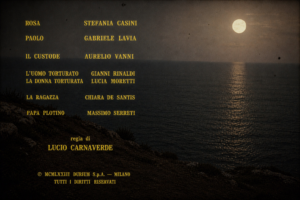
There is no known complete copy of Zombi Bellissima, the 1973 Italian horror film attributed to the elusive director Lucio Carnaverde. No archive holds a print. No restoration has ever been attempted. There is no confirmed runtime. However, fragments of the film persist through its vinyl album soundtrack, a handful of paperback copies of its novelization, and – most rare of all – a seven-inch reel of the film on Super 8 film.
But its rarity isn’t what makes Zombi Bellissima so odd. The movie hasn’t been lost over time in the traditional sense. It is said to have been intentionally locked away forever because of a set of testimonies that are unusually consistent in one specific way. Everyone whoever saw it claimed to suffer from hallucinations and temporal displacement.
What Is Known
On paper, Zombi Bellissima appears unremarkable. A low-budget Italian horror production, reportedly screened in a handful of cities in Italy and the United States during the summer of 1973. Oddly, the credited director, Lucio Carnaverde, has no verifiable biography. His name appears nowhere else in Italian cinema. He seems to have no prior work, no later work, no registration with any guild or production body.
The film itself was withdrawn shortly after that short summer run. One contemporary trade publication that can be found to have reported on it claimed the film suffered from incomplete post-production, sound issues, complications with distribution. However, for no reason whatsoever and in a clearly unconventional act, the original negative of Zombi Bellissima was gone within days of its initial run.
There was no public ban. No scandal. No investigation. Simply put, Zombi Bellissima was just removed from the public entirely for no real reason.

The Plot as We Understand It
From what can be compiled through old newspaper articles and limited available materials, the plot of Zombi Bellissima follows Rosa, a young woman suffering from radiation-induced memory loss after a catastrophic gamma ray burst strips Earth’s atmosphere and floods the world with lethal solar exposure.
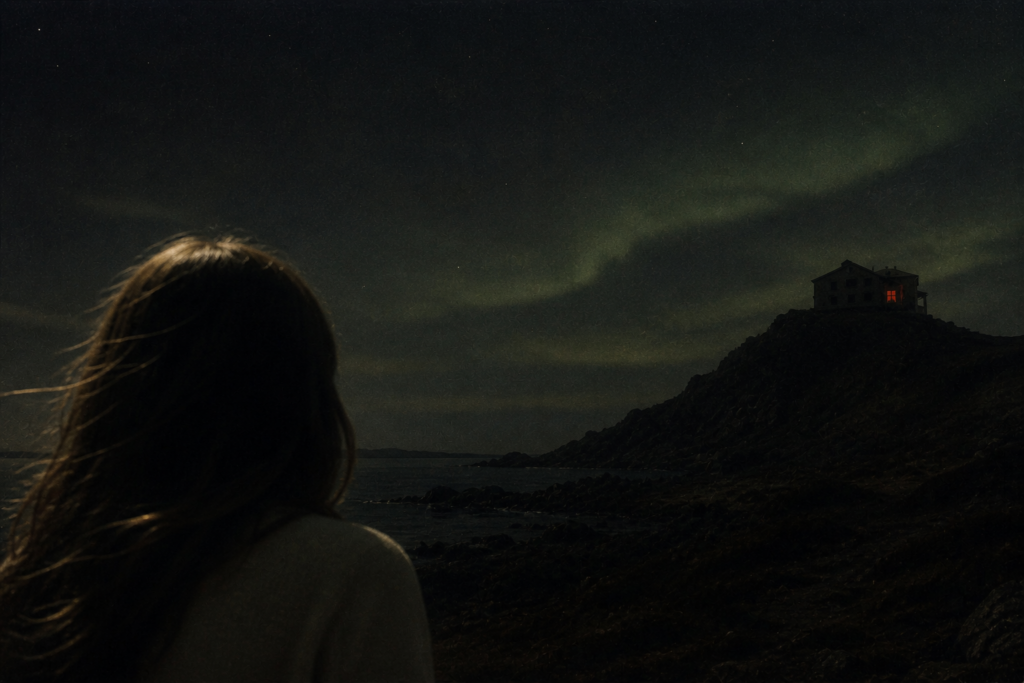
Traveling by boat to her childhood island to fulfill a fading desire to climb its mountain and see the full moon one last time, she arrives disoriented, discovers the corpse of her dead companion, and wanders into a decaying landscape where a sadistic cult preys on the afflicted.
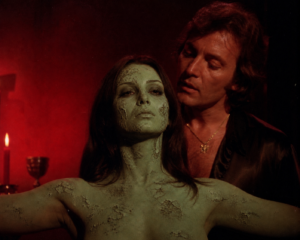
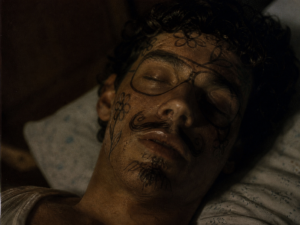
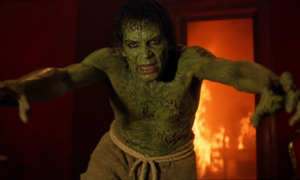
The viscous cult marks these diseased individuals as “impure” by covering them in green body paint and subjecting them to ritualized torment until a violent uprising of the green-skinned victims tears the community apart, forcing Rosa to flee upward through a hostile, fractured world she cannot fully comprehend.

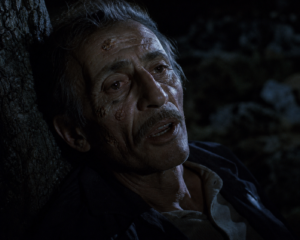
Guided only by instinct and fragments of memory, she encounters a dying old man who recounts the allegory of the “Beach of the Dead”, a philosophical monologue understood by the audience as the moment when the end is already determined but cannot yet be understood.
Venturing on, Rosa reaches the mountain’s summit before dawn, where survivors and their pursuing aggressors rush past her to their deaths below. Rosa remains still and steadfast, refusing both action and escape, and in that suspended moment of pure awareness, she witnesses the impossible.
That’s all we know.
Initial Reports Of Hallucinations
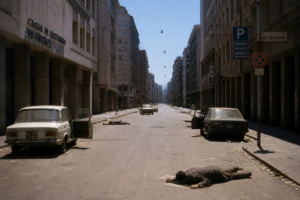
The film’s first screening was attended by critics, distributors, and industry professionals. Their accounts, gathered informally in the investigative years that followed, align only in the broadest possible plot outline: a woman named Rosa, a coastal village, a mountain, a ritual or ceremony, and a final image involving the moon. Beyond that, the record fractures.
Some of the attendees described extended sequences that no one else could confirm. Others insisted that entire sections were missing. Moments that one viewer considered central to the film were absent from another’s memory entirely. The contradictions were structural and vast.
More unsettling, however, were the temporal inconsistencies. Several viewers reported that the film felt longer than it could have been, while others described it as ending abruptly, as if key scenes had been removed mid-projection. A small number claimed that parts of the screening itself seemed to pass without being experienced at all.
When The Government Intervened
Rumors began swirling that the explanation for these contradictions was chemical. Authorities suspected that theaters were intentionally exposing audiences to hallucinogens, with LSD-laced concessions specifically cited in early internal communications.
Soon after these allegations were made, a private screening from the Italian government was arranged under controlled conditions with independent projection and medical oversight while using soldiers in a sealed environment as its test audience.
The results of that screening remain classified to this day.
However, what is known is that the drug theory was abandoned immediately. The reports produced by officials mirrored the original audience’s accounts. The soldiers also experienced fragmented, inconsistent, and irreconcilable experiences. No external contamination was identified, and no projection anomaly seemed to have occurred.
The moon As Catalyst
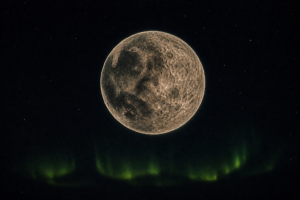
Across all accounts – whether industry professionals, the Italian government, or the general public – one element remained consistent. The moon.
Viewers described the moon having appeared in locations in the night sky where it should not have been visible. Sometimes they saw it behind interior spaces, positioned at impossible angles, or hanging too large in the sky to be physically plausible. But the most disturbing reports concern not where it appeared, but what it was doing.
A majority of attendees described a moment at which the moon began to turn. They recalled seeing a slow, deliberate shift where it stopped mid-motion after revealing the surface of its dark side from the terrestrial plane.
These moments were said to have been accompanied by immediate physiological responses such as panic attacks, disorientation, and, in a handful of cases, attempts to leave the theater. At least two accounts describe viewers becoming convinced that the projection had malfunctioned.
The problem, noted later in internal reports, is straightforward. The Moon is tidally locked to the Earth. Its visible face does not rotate from our perspective. No practical or optical method available in 1973 could convincingly depict such an effect within a grounded cinematic image, especially not in a way that varied from viewer to viewer.
This leaves a question that appears repeatedly throughout known documentation: If the film did not contain a rotating moon, then why did so many viewers remember seeing one?
How The Film Sees Zombies
In Zombi Bellissima, the “zombies” are not creatures in the traditional sense. They are the exposed, those who have already been condemned by radiation. Their bodies are failing, their time is finite, and everyone knows it. They are, in the most literal sense, the walking dead. Not because they have physically died, but because their death has already been decided.
What Zombi Bellissima does with that idea is a return to original Haitian concept of a person who believes they are dead and allows themselves to be controlled by a living shaman. In the film, those who were spared the exposure believe themselves “pure” and do not fear the infected. In fact, quite the contrary. They use them.
The doomed are marked, controlled, and repurposed as labor, as spectacle, as objects of ritual punishment. Their time is considered worthless, and so they are treated as if they no longer exist within it. What remains of their lives is no longer seen as life at all. And yet, they accept it because it is still something.
Interaction, even in the form of cruelty, becomes preferable to absence. To be seen – even as an object – is to still exist. The alternative is isolation and disappearance, a kind of social death that precedes the physical one. This is the film’s central tension.
At the top of the mountain, the old man’s allegory of “The Beach of the Dead’ reframes everything. Death is not an event. Instead, it is a condition that can be entered before the body fails. The moment the end becomes inevitable, time changes. It no longer moves forward as possibility. It collapses into certainty. From that point on, the question is no longer what will happen. It is how to exist when it already has.
This is where the film’s reported effects begin to make sense. Viewers do not describe traditional hallucinations. They describe a loss of alignment with time itself. Scenes feel longer than they are, or shorter. Moments repeat, but not consistently. The experience is not of watching time pass, but of being held inside it. Like gravity bending space around a mass, the film appears to bend time around perception.
The viewer is no longer outside the story. They are subjected to its logic, which helps explain why the full version did not survive public circulation. If the film functions as a sort of metaphysical, philosophical catalyst, then the experience cannot be contained within the screen and becomes dangerous to social structures and the status quo as a whole.
A Director With No Past
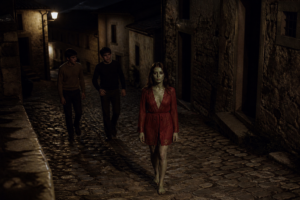
The director of Zombi Bellissimo, “Lucio Carnaverde”, does not exist in any verifiable record of Italian cinema. There is no documentation tying the name to a real individual, either. No production history. No known collaborators. The assumption that it is a pseudonym is nearly universal.
Who, then, made the film remains unresolved.
Some theories place Carnaverde within Italy’s experimental film circles of the early 1970s, suggesting a figure working deliberately outside institutional structures. Others point to private funding networks, possibly tied to aristocratic or academic interests operating at the margins of the industry.
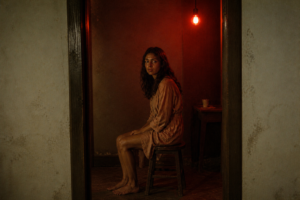
A smaller but persistent line of speculation proposes that the film may not have been Italian in origin at all. Names surface periodically in discussions: Antonioni, for the film’s philosophical tone; Argento, for its horror elements; Fellini, for its reported dream logic. However, none of these associations hold under scrutiny.
And yet one theory, dismissed by most historians but difficult to entirely extinguish, continues to circulate. That theory: Zombi Bellissima may have been the result of an uncredited collaboration, or private experiment, connected in some way to Stanley Kubrick, who was known at the time to be exploring questions of perception, time, and narrative structure under tightly controlled conditions.
There is, of course, no evidence to support this. Yet the theory persists.
One Version That Survived
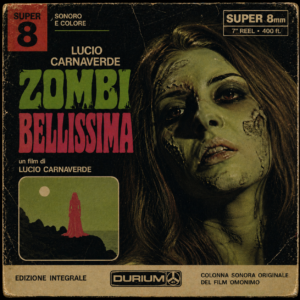
Despite the disappearance of the original film, one version miraculously remains. Albeit, by total accident. Prior to the initial screening, it is said that Carnaverde personally oversaw and laid out the Super 8 version of Zombi Bellissima.
At the time, Super 8 was a consumer format, designed for home viewing. Feature films were occasionally reduced to that format for the general public to purchase, but these versions were typically shortened by a tremendous length, simplified, and produced without direct involvement from the original filmmakers. This case appears to be different.
The Super 8 version of Zombi Bellissima, directed and produced by Carnaverde himself, was not treated as another reduction. It was restructured into a standalone film in its own right. Scenes were removed. Transitions were intentionally broken. Narrative continuity was deliberately abandoned in favor of fragmentation. And what remains is a seventeen-minute masterpiece that is self-created and far from just a cheap adaptation.
Following reports of hallucinations and temporal displacement, authorities moved to confiscate all known materials associated with the film. What they did not account for was timing. A limited number of Super 8 prints had already been produced and distributed in a number of department store chains. Most were recovered.
Rumors persist of surviving copies held in private collections, stored in estate archives, or circulating quietly without verification. No confirmed public screening has ever taken place. Those who claim to have seen a copy tend to describe the experience as traumatic.
The Novelization
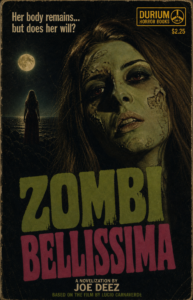
Unlike the Super 8 film, the original novelization is in public circulation today, although often difficult to find and expensive when discovered. Printed once in 1973 under the Durium Horror Books label, it presents a complete narrative, detailing the events that could only be implied by the surviving film fragments: Rosa’s true journey; all encounters on the island; the true nature of the torture cult; the locals living on the mountain; and, most disturbing of all, Rosa’s final encounter with the moon.
It is coherent and structured, yet readers familiar with the film’s mythology often report an unusual sensation while reading it. This sensation is often described as the text clarifying events the reader already remembers; even when they have never seen the film.
Reconstructing the Film Through Sound
If the Super 8 version of Zombi Bellissima presents a fractured narrative, and the novelization provides us with unlocked memories out of time, then the soundtrack offers something far more structured. Not openly, and not in a way that can be easily diagrammed, but with enough consistency that a pattern becomes difficult to ignore.
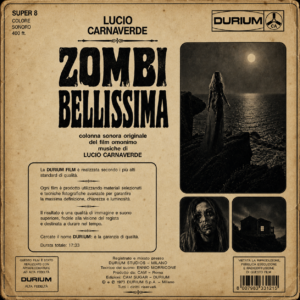
The soundtrack is the only widely available artifact. Released on vinyl also in 1973 and later circulated online, it is widely regarded as a minor masterpiece; minimal, repetitive, and structurally precise. It has been looked over and deconstructed with a fine-tooth comb. And although there is no evidence of subliminal messaging or hidden audio content, listeners consistently report experiencing something abnormal.
They have described sections of the album that feel longer than their recorded runtime, loops that resolve differently with each listen, and vocal impressions that do not appear in the official lyrics. More strikingly, many report a subtle but persistent distortion in temporal perception.
For example: a track that should last three minutes feels closer to five. They claim that a passage repeats, but not as remembered. It seems that the recording itself does not change but the listener’s perception of time and sensory comprehension seems to.
With the exception of the mysteriously titled “Opening Reprise”, each track appears to correspond to a distinct movement within the film’s three-act progression. Taken together, the songs seem to accompany the pacing of the Super 8 cut.
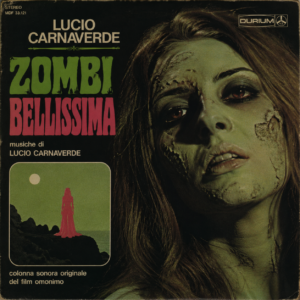
What makes this alignment more difficult to dismiss is the phenomenon of temporal displacement that has been reported consistently by listeners over time. The order of the soundtrack album is as follows:
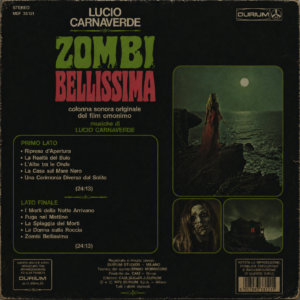
Primo Lato (First Side)
- Ripresa d’Apertura (Opening Reprise)
- La Realtà del Buio (The Reality of Darkness)
- L’Alba tra le Onde (The Dawn Among the Waves)
- La Casa sul Mare Nero (The House on the Black Sea)
- Una Cerimonia Diversa dal Solito (A Different Kind of Ceremony)
Lato Finale (Final Side)
- I Morti della Notte Arrivano (The Dead of the Night Are Coming)
- Fuga nel Mattino (Escape into Morning)
- La Spiaggia dei Morti (The Beach of the Dead)
- La Donna sulla Roccia (The Woman on the Cliff)
- Zombi Bellissima (Beautiful Zombie)
Taken individually, these tracks can be dismissed as experimental composition. Taken together, they form a complete progression that aligns precisely with the missing structure of the film. Introduction. Disruption. Escalation. Explanation. Withdrawal.
If the Super 8 version removes the visible connective tissue of the narrative, the soundtrack restores it. And if temporal displacement is not a byproduct, but a function, then the soundtrack is not simply accompanying the film. It is controlling how the story is experienced in time.
Conclusion
The reason the original version of Zombi Bellissima was sealed has never been stated outright, but the pattern is difficult to ignore. Every documented viewing produced the same result: a collapse in temporal perception, followed by a sustained inability to reorient fully to normal experience where hallucinations centered in how time and consequence are perceived take center stage.
The complete version remains inaccessible, but there are fragments if you can find them. The soundtrack is available online. The novel can be read, in theory. The Super 8 version, in part, still circulates. You can approach Zombi Bellissima, piece by piece, and decide for yourself whether the accounts are exaggerated, misunderstood, or accurate. Just understand what is being suggested: that the experience is not confined to the film itself.
So, if you choose to follow it far enough to find out, the only reliable outcome (according to every version of the story) is that something about your sense of time will not return exactly as it was before you experienced Zombi Bellissima.